To backtest an MT5 gold EA the right way, you need real tick data, multi-year coverage, and a clear-eyed reading of the strategy tester report. Anything less, and you're optimizing for a fantasy that won't survive its first live week on XAUUSD.
This guide explains how to set up the MT5 Strategy Tester properly and how to interpret the metrics that actually matter — drawdown, profit factor, recovery factor, and Sharpe ratio. For a working example, see our latest XAUUSD backtest report on Exness real-tick data — the same workflow described below, run on a live broker.
Setting up the MT5 Strategy Tester
Open View → Strategy Tester (Ctrl+R) and configure the run:
- Expert Advisor: select the EA you're testing.
- Symbol: XAUUSD on the same broker server you'll trade live. Different brokers have different historical data.
- Period: H1 or M15 — match the EA's design.
- Modeling: always "Every tick based on real ticks." The other modes are faster but lie.
- Date range: minimum 3 years. 5+ is better. Anything less than 1 year is a coin flip.
- Initial deposit: match what you'll trade live.
MetaQuotes' official testing documentation covers each setting in depth.
Reading the report: the four metrics that matter
1. Maximum drawdown (%)
The biggest peak-to-trough equity decline. If the report shows 28% max drawdown, ask yourself honestly: would you keep trading after losing more than a quarter of your account?
- Under 15%: excellent — psychologically tradable.
- 15—25%: realistic for a working strategy with edge.
- Over 30%: red flag, even if returns look great.
2. Profit factor
Gross profit divided by gross loss. PF of 1.5 means the EA earns $1.50 for every $1 lost.
- 1.2—1.6: realistic and sustainable.
- 1.6—2.5: very good — if drawdown is also reasonable.
- Over 4: almost always over-optimized. Be skeptical.
3. Recovery factor
Net profit divided by max drawdown. Tells you how efficient the strategy is at producing returns relative to the pain. A recovery factor over 3 is solid; over 5 is excellent. Below 1 means the EA spends more time clawing back losses than making money.
4. Sharpe ratio
Risk-adjusted return. The CME Group's Sharpe ratio explainer covers the math, but the rule of thumb: above 1.0 is good, above 1.5 is excellent, above 2.0 is rare and worth investigating for over-fitting.
The biggest backtest trap: curve fitting
Curve fitting is when an EA's parameters are tuned so tightly to historical data that they no longer work on anything else. Symptoms:
- Win rate above 85% with shallow drawdown.
- Massive profit on the optimized period, garbage on out-of-sample.
- Tiny changes to inputs collapse performance.
The defense is walk-forward testing — optimize on 2018—2022, validate on 2023—2025 untouched. If the validation period stays profitable with similar drawdown, you have a real edge. If it falls apart, you have a beautifully fitted curve and nothing more.
Personal insight: the trade list tells more than the headline
After reading hundreds of strategy tester reports, the single most useful section is the trade-by-trade list. Look for:
- Cluster of losses in any single month — usually a regime the EA can't handle.
- Outsized winners doing all the heavy lifting — fragile dependency on a few trades.
- Long stretches of small wins followed by one giant loss — classic martingale signature.
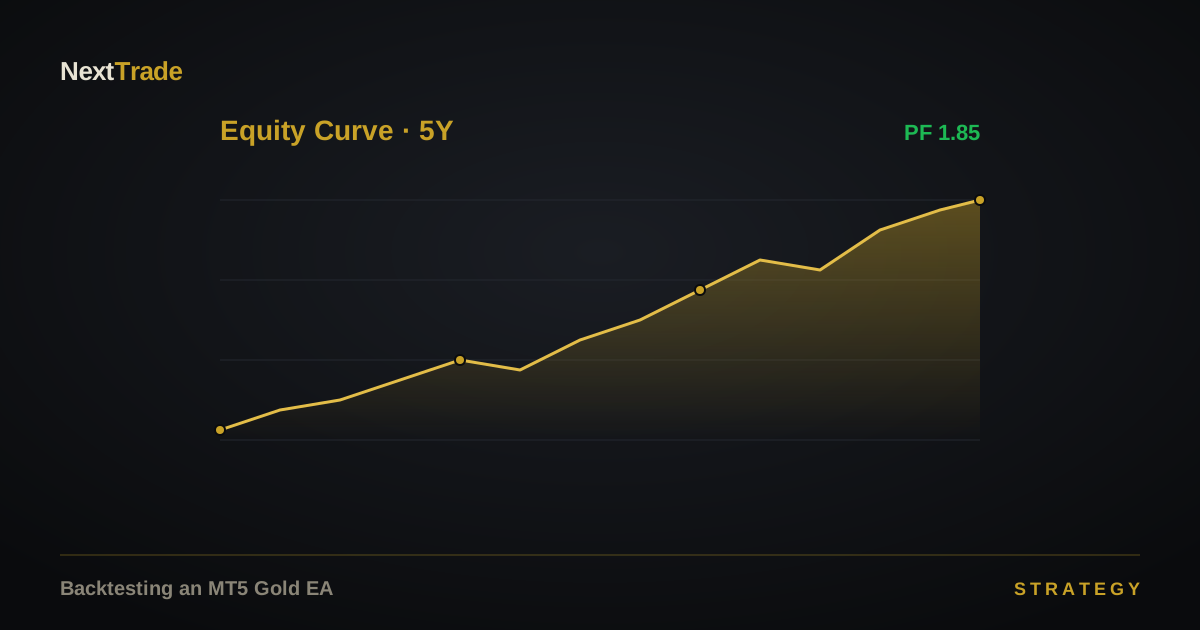
A healthy equity curve climbs steadily with limited variance, not in dramatic bursts. For an example, see how NextTrade documents its rule logic openly, and check the trade-by-trade list from our latest published run — every fill, every hold-time, every TP, with the broker and modelling settings beside them.