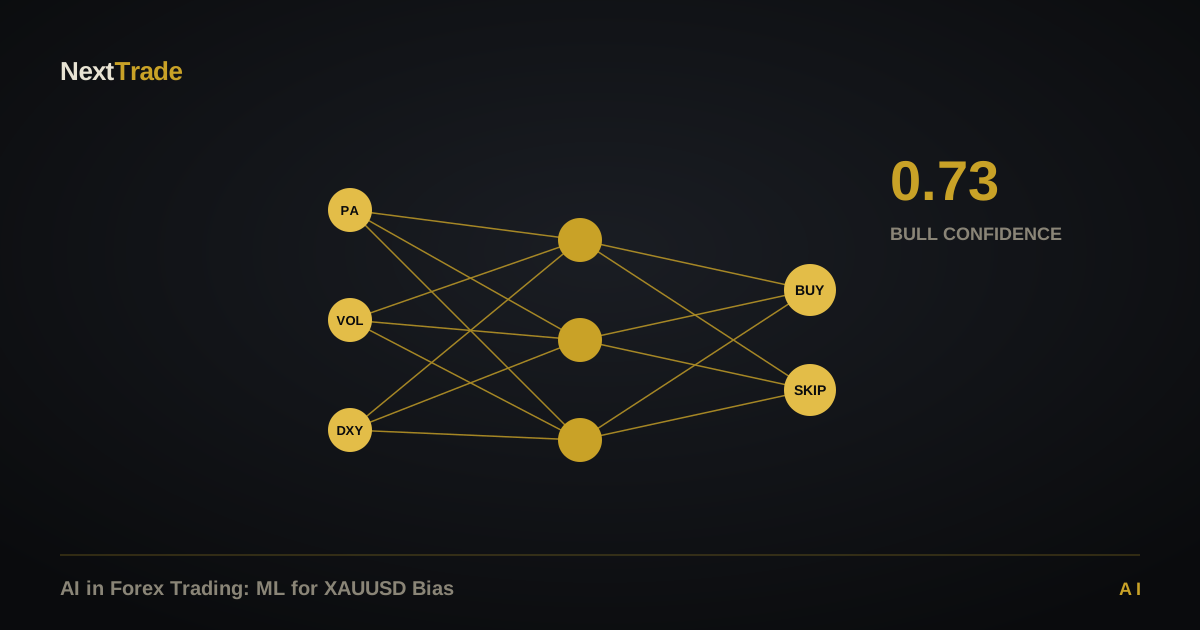
AI in forex trading — specifically, machine learning applied to XAUUSD — is not a magic signal generator. It's a classification layer that assigns each market state to a directional bias (bullish, bearish, or neutral) based on features the model has learned to associate with subsequent price behavior. Done well, it filters out low-quality setups. Done badly, it's a black-box random-number generator dressed in Python.
This article explains what candle pattern actually is, what it can and can't do on gold, and how modern Gold EAs integrate it without sacrificing transparency.
candle pattern vs. traditional EA logic
A traditional rules-based EA makes decisions from explicit thresholds: "if RSI < 30 and price is above the 200-EMA, go long." The logic is readable and reproducible.
An candle pattern layer adds a second opinion. Before the EA takes a signal, a trained model evaluates the current market state and scores it: bullish_probability = 0.73. If the score is below a threshold (say 0.55), the signal is vetoed. Same strategy; fewer, higher-quality trades. NextTrade ships this exact pattern as a toggleable input — see the candle-pattern confirmation in the full feature list.
What features actually feed the model
For XAUUSD specifically, useful features fall into four buckets:
- Price-action — recent swing structure, candle-body ratios, multi-timeframe trend slopes.
- Volatility — ATR rankings, realized vs. implied vol, spread behavior.
- Intermarket — DXY, US 10-year yields, SPX, BTCUSD. Gold's macro drivers.
- Time-of-day — session, day-of-week, pre/post-rollover.
The NIST AI Risk Management Framework describes the importance of feature transparency — any model whose inputs you can't enumerate is a model you can't debug when it breaks.
What AI can do for XAUUSD
- Skip chop — the single biggest win. Most rules-based systems bleed during ranging conditions; a bias model that detects low-trend-strength environments helps the EA stay flat.
- Scale down risk in uncertain regimes rather than pretending every trade is equivalent.
- Detect regime shifts faster than manually tuned thresholds.
- Combine weak signals from multiple indicators into a single confidence score.
What AI can't do (and claims that should worry you)
- Predict FOMC outcomes. No model has the inside information; claims otherwise are sales copy.
- Reliably forecast beyond a few hours. Markets are adaptive — an edge that holds for years is rare.
- Replace risk management. A model that's right 80% of the time still needs stops. Nobody is 80% correct for long.
- Work without retraining. A model trained on 2019—2022 gold data will degrade by 2026 without periodic refresh.
If a product markets "AI predictions with 94% accuracy," it's either cherry-picked, over-fit, or both. A responsible implementation reports cross-validated accuracy (typically 55—65% for useful models) and admits the limitations.
How NextTrade integrates candle pattern
NextTrade uses its AI layer as a gate, not a generator. The rule engine produces the signal; the AI model scores it; anything below threshold is skipped. This architecture has two important properties:
- The base strategy is independently tradable and auditable — you can turn candle pattern off and the EA still works, just with more trades.
- Model failures fail safe — a broken classifier vetoes everything, resulting in zero trades rather than random trades.
See the full architecture in the how-it-works page.
Personal insight: the sweet spot is 0.55—0.62 confidence
Across our own live testing, bias thresholds set too high (≥0.70) starve the EA of trades, while thresholds too low (≤0.50) defeat the point. The productive range is 0.55–0.62 — filters out the weakest setups without collapsing trade frequency. The optimal value isn't fixed; it drifts slightly with volatility regime. You can see the threshold tuning play out in our latest XAUUSD backtest report, which uses 0.58 as the default.