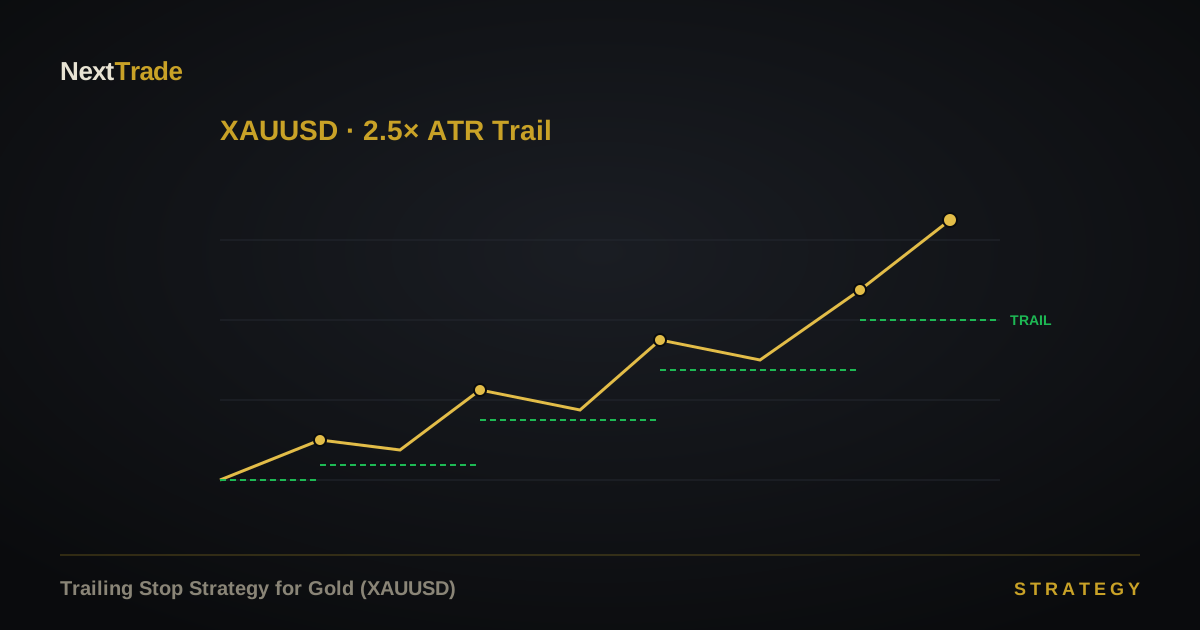
A good trailing stop strategy for gold does two jobs at once: it protects the profit already earned, and it gives the trade enough room to capture the rest of the move. On XAUUSD, where 30-pip whipsaws happen mid-trend, getting this right is the difference between a +1R winner and a +3R runner.
This article walks through the three trailing approaches that actually work on gold, when to use each, and the mistakes that turn trailing stops into premature exits.
What a trailing stop is (and isn't)
A trailing stop is a moving stop-loss level that advances in the direction of profit and never moves backward. If you're long XAUUSD at 2,410 with a stop at 2,400, a 10-pip trailing stop moves up as price moves up — at 2,415 the stop is at 2,405; at 2,420 it's at 2,410. If price reverses, the stop stays put and closes the trade there.
What it isn't: a replacement for a proper initial stop. The initial stop exists because the trade idea can be wrong from the start. The trailing stop exists once the trade is in profit and the risk becomes "how much of the gain do I give back?" Investopedia's trailing-stop definition covers the mechanics in detail.
Three trailing approaches that work on gold
1. ATR-based trail
The most adaptive method. The stop trails price by a fixed multiple of the Average True Range — typically 2× to 3× ATR on H1 for XAUUSD. When volatility expands, the stop gives the trade more room; when it contracts, the stop tightens automatically.
Example: H1 ATR of 8 pips with a 2.5× multiplier → trail distance of 20 pips. A quiet morning might see that narrow to 12 pips; a CPI release might widen it to 35. The ratio stays constant while the absolute distance breathes with the market.
2. Structure trail (swing high/low)
Instead of a fixed distance, the stop trails beneath the most recent confirmed swing low (for longs) or above the most recent swing high (for shorts). It's slower to move but respects market structure — you don't get kicked out by noise that didn't violate the trend.
Best for swing trades holding multi-day moves. Less useful on scalps where swings form too infrequently to trail anything. NextTrade Gold EA's swing engine uses the same swing detection logic for entries — see how it identifies confirmed swing highs and lows on the decision-flow page.
3. Breakeven + partial close
A simpler hybrid: once price reaches 1R in profit, move the stop to entry (breakeven) and close half the position. The remaining half runs with either an ATR trail or a structure trail. You bank a guaranteed small win and let the rest chase a bigger one.
This approach has a psychological benefit worth naming — after banking the partial, traders are far less likely to close the runner prematurely out of fear. Babypips' trailing stop guide covers partial-close mechanics for retail traders.
What doesn't work for gold
- Fixed-pip trails under 15 pips — gold's normal intra-hour noise is larger than this. Your stop gets hit mid-trend, repeatedly.
- Percentage-based trails — gold's 1% is ~$24, which is enormous relative to typical stops. Works fine on equities; overkill on currency pairs.
- Candle-close trails on M1 — you'll be adjusting 60 times an hour for no benefit.
When to move to breakeven
The classic rule "move to breakeven at 1R" works, but it's aggressive. On XAUUSD, a slightly more forgiving version — breakeven at 1.5R — leaves more trades alive through normal pullbacks. The 1R version has higher trade-win-rate; the 1.5R version has higher expectancy. Both are defensible; pick one and measure.
Avoid the opposite mistake: never moving stops to breakeven at all. Gold can retrace 70% of a move before resuming. A trade that was +2R and closes at -1R is worse than a loss — it's a loss that already showed you the win.
Partial closes: 50% or 33%?
Two common structures:
- 50% at 1R, 50% runner — symmetric, guarantees break-even at minimum.
- 33% at 1R, 33% at 2R, 34% runner — three exits, smoother equity curve, more complexity.
For mechanical EAs, 50/50 is almost always the right choice — fewer moving parts to optimize, less curve-fitting risk.
How NextTrade handles trailing
NextTrade Gold EA uses an ATR-based trail (2.5× H1 ATR by default) combined with a breakeven+partial at 1R. Both are exposed as inputs — if you want a tighter trail for ranging markets or a wider one for trending sessions, it's a parameter change, not a code change. See the implementation in the features page.
Personal insight: the trail that pays is the one you let work
The single biggest trailing-stop mistake we see isn't the trail distance — it's manual intervention. Traders set a 2× ATR trail, then close the trade manually because "it looks weak." Across a year of data, those discretionary exits cost more than any trail-distance tuning ever saved.
The discipline: if the trail hasn't hit, the trade is alive. Let the rules work. For deeper context on why mechanical execution outperforms discretion on automated systems, see our risk management guide. The live backtest report demonstrates this in practice: every trade hit TP without manual intervention.